Stress Relaxation Cracking
General Information
Interest in Stress Relaxation Cracking, sometimes referred to as Reheat Cracking, Stress Relief Cracking, or Strain Oxidation Cracking, began to rise approximately 20-30 years ago. This increase coincided with a growing number of “mysterious” failures observed in austenitic stainless steels and nickel alloys operating within theoretically safe temperature ranges. Failures of welded pipelines and equipment made from high-temperature stainless steels (such as 321ss - UNS S32100) or nickel alloys (such as 800H - UNS N08810), characterized by an intergranular cracking pattern, were often attributed to modes such as creep cracking assisted by oxidation.1 2 3 Studies by van Wortel and others have confirmed that the relaxation of accumulated stress, particularly in cold-worked areas such as bends or near welds’ Heat-Affected Zones (HAZ), aided by high temperatures (typically below the maximum service temperature limits for the given steel), is the primary driver for SRC.5
Despite the research efforts made over the last two decades, several areas remain open for study. These include the impact of alloy impurities, determining SRC critical temperature, and developing a more quantitative approach to assessing and predicting SRC likelihood. The slow development of knowledge on SRC is exemplified by successive changes and updates in the corrosion mechanisms normative API RP571.
In its early release, this normative primarily recognized SRC (commonly referred to as Reheat Cracking) with limited information on influencing factors and prevention techniques, mainly through Post Weld Heat Treatment (PWHT). However, after nearly two decades, the latest release of API RP 571 acknowledges SRC as a separate damage mode (with reheat cracking now used as a secondary term) and provides more specific details on temperature impacts, detection methods, and mitigation procedures.6 However, the focus of this normative is limited to four groups of materials:
- 1Cr-½Mo, 1¼Cr-½Mo ,
- 2¼Cr-1Mo-V,
- Selected 300 series: 347 (UNS S34700), 321 (UNS S32100), 304H (UNS S30409),
- nickel-based alloys (detailing only 800H/HT - UNS N08810/N08811).
Table 1 show some of typical locations for SRC in refining and petrochemical industries.
Table 1 SRC expected areas. after 1 2 4 6 7 8
| Process Unit | Operation Area affected by SRC |
|---|---|
| Ethylene Plant | HT operating pipelines with welds on potentially high stress loaded areas: • cracker coils (inlet pigtails), reported on 312H. |
| Hydroprocessing Units | Recycle hydrogen heater to the reactor inlet/outlet lines made of 321 and 347. |
| Reforming Fluid Catalytic Cracking | Hot-wall vessels and piping operated >480°C (900°F) especially at: • toe of nozzle-to-shell welds • reinforcement pads • welds on high stress loaded pipelines. |
| Steam Reforming (H2 production) | • Reformer outlet piping (outlet pigtails, bends) – most common areas, several reported failures of 800H/HT • Steam superheaters tubes |
| Utility | HP Steam pipes made of 1Cr-½Mo ,1¼Cr-½Mo operating >480°C (900°F) especially at: • circumferential welds at high stress loaded areas |
Mechanism
Stress relaxation cracking is typically characterized as intergranular fracture, predominantly occurring within the coarse-grained Heat Affected Zone (HAZ). It is commonly observed during the welding of heavy-wall equipment made of high-temperature stainless steels or nickel alloys.9 It is widely agreed that SRC is induced by the relaxation of high residual stresses resulting from either cold or hot deformation of the materials. However, the exact micro-mechanism remains inconclusive.5 9 10 11 . Some authors suggest that the formation of Nb(C,N) and Ti(C,N) carbides may play a role in SRC, particularly in materials such as 347 and 321. Others emphasize the significance of intergranular carbide precipitation (such as Fe(Cr,Mo)-rich M23C6) or intergranular segregation of phosphorus and sulfur.9 10 12
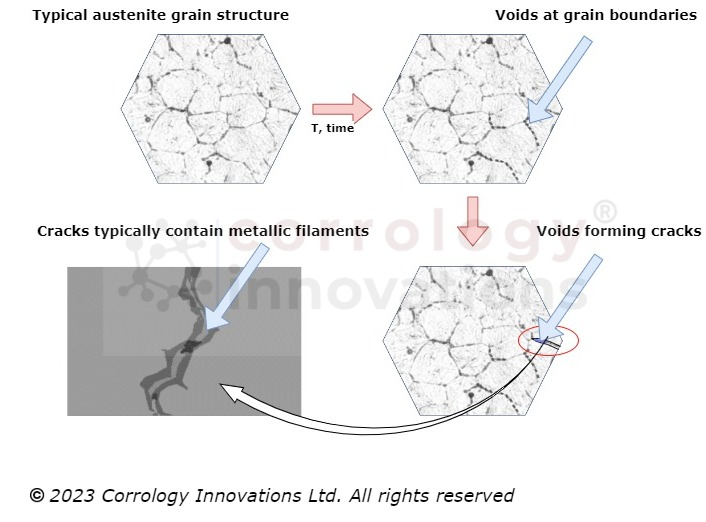
Regardless of the potential micro-mechanism, there is a consensus that a significant increase in hardness at grain boundaries, caused by carbide precipitation, P,S segregation, or other factors, restricts the deformation capacity within the grains, thereby acting as a driving force for SRC (see Figure 1).
The stress relaxation cracking mechanism possesses several specific elements that aid users in its proper recognition. These distinct ‘fingerprints’, as outlined in the literature, include:5 8 10 11 12
- Intergranular cracking pattern with a number of small cavities (precipitates) along grain boundaries.
- Cracks predominantly occurring in the Heat Affected Zone (HAZ) or cold worked areas.
- Presence of a metallic filament at crack tips, particularly in alloys such as 347, 321, or 800H/HT (Fe-rich in 321/347, Ni-rich in alloy 800H/HT). Note: over-etching may dissolve the metallic filament hence it should be done very carefully in order not to destroy the metallic parts. For some alloys (617) the metallic filament may not be present,
- Typically, the filament is surrounded by a Cr-rich oxide layer.
- High hardness observed in the Coarse Grained Heat Affected Zone (CGHAZ). While some authors indicate that a hardness of HV>200 is a clear indicator of SRC conditions, it should be noted that this is a generic indicator, as some papers report no significant difference between parent metal (PM) and HAZ/weld metal hardness.
Key Variables
SRC is influenced by several factors, with key roles typically attributed to temperature, applied stress, and material composition. Some authors have also suggested that the concentration of carbon (C) and nitrogen (N) plays a role in determining susceptibility to SRC.10 Below is an overview of the existing understanding of how various parameters impact SRC.
Temperature & Time
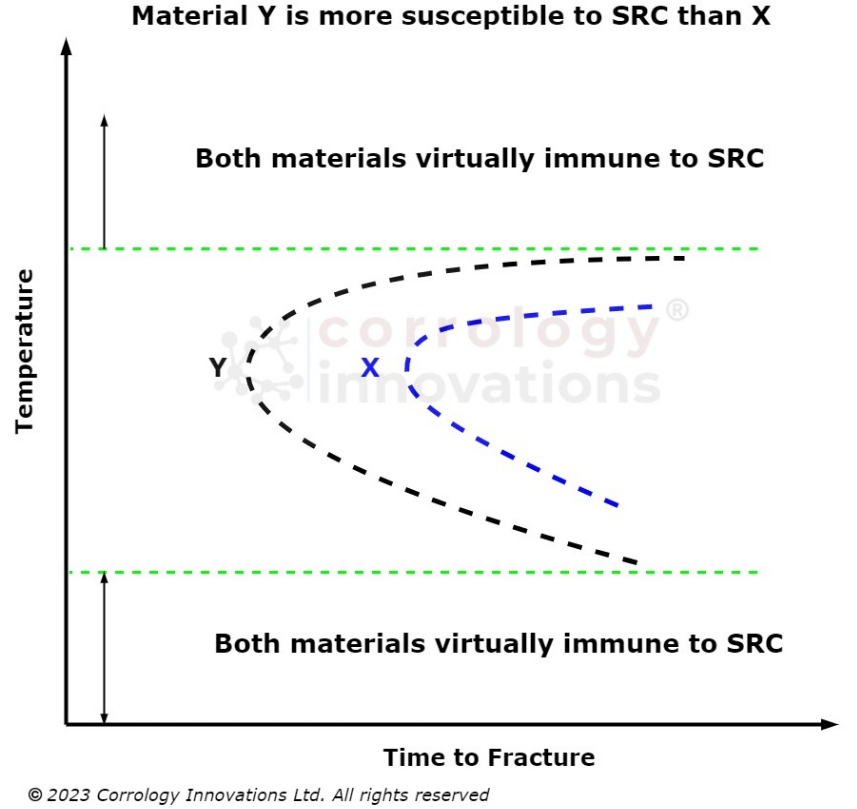
Components made of stainless steels and nickel alloys operating within the temperature range of approximately 500-750°C (930-1380°F), and low alloy steels (1 to 2¼ Cr, ½ to 1 Mo) within the temperature range of 450-480°C (840-900°F), are typically considered susceptible to Stress Corrosion Cracking (SRC) when subjected to welding or cold working.5 6 However, it is recommended to exercise caution when adhering strictly to these guidelines, as the susceptibility to Stress Corrosion Cracking (SRC) may vary and typically peaks in the middle of the temperature range (though this is not a strict rule). Figure 2 illustrates typical curves obtained from high-temperature tensile tests, which are commonly used for SRC screening. These tests generally analyze the relationship between temperature and the ductility of the material. Materials with lower stress accommodation capabilities at a given temperature are expected to be more susceptible to SRC.10 13 14 Of course, the isolines will change depending on the applied fracture stress level and the type of heat treatment (after cold work) or post-weld heat treatment (PWHT) applied. It’s important to emphasize that laboratory evaluations regarding Stress Corrosion Cracking (SRC), and consequently various normative documents derived from them, serve as generic advisories providing qualitative justifications for certain alloys. For specific alloy-temperature data, please refer to the Materials section.
Impurities and microstructure
The microstructure, particularly the grain size, was initially postulated as an important factor influencing the material’s susceptibility to Stress Corrosion Cracking (SRC).9 12 The assumption that materials with coarser grains are more prone to Stress Corrosion Cracking (SRC) than those with fine-grain matrices was initially proposed. However, this postulate lacks undisputed confirmation. Some studies suggest that fine-grain matrices, as observed in Alloy 800HT and 347, have a positive effect on SRC resistance. In certain cases, such as Alloy 800HT, fine grains of ASTM size No. 6 have been observed in cracked areas. Conversely, other research indicates that grain size may be of less importance, particularly in various nickel alloys and 316LN.5 7 9 12 14 15
The significance of alloying elements and impurities is postulated to be higher than factors such as grain size. Research has indicated that increasing chromium content above 25% contributes to establishing a material’s immunity to Stress Corrosion Cracking (SRC). However, this observation is more generic in nature than a solidly established fact.5 12 The presence of carbide-forming elements such as Nb and Ti is beneficial for enhancing a material’s creep resistance performance. However, in some cases, their presence may inadvertently promote Stress Corrosion Cracking (SRC).14 16 17
Other elements such as carbon, nitrogen, phosphorus, or sulfur are also purported to play a role in grain boundary precipitation.17 19 Studies on 316L material, which is rarely used for high-temperature (HT) applications, have shown no decisive evidence of the impact of elements such as phosphorus (P), carbon (C), or nitrogen (N).10 Similarly, the lack of evidence regarding the key role of elemental segregation caused by so-called “tramp elements” like sulfur (S), phosphorus (P), aluminum (Al), etc., on Stress Corrosion Cracking (SRC) has been observed in the case of ferritic stainless steels (2¼Cr-1Mo).18 While the presence of impurities or tramp elements may contribute to grain boundary segregation, leading to phenomena such as liquidation cracking, their influence on SRC appears to be of secondary importance.
Materials
To to find out more to find out more about materials affected by Stress Relaxation Cracking please upgrade your subscription.
References
    This Article has 23 references.

    Upgrade to a Paid Subscription to see the references details.