Amine Corrosion
General Information
Removal of acidic compounds (H2S, CO2, COS etc.) from hydrocarbon streams, both liquid and gaseous, is a critical aspect of refinery operations. The purification of hydrocarbon streams from acidic compounds is commonly achieved through the absorption-desorption process, employing various alkanolamine-based solvents.
Figure 1 illustrates a typical amine unit configuration with a simple absorber/contactor – regenerator setup. However, variations of this arrangement are also possible, depending on factors such as treatment type, the solvent used, or the type/concentration of acid compounds.
 [2](#reference2) [3](#reference3)](/img/amine%20corrosion/Amine%20Corrosion_Figure%201.drawio.svg)
The following are four amine solvents predominantely used in sweetening units:
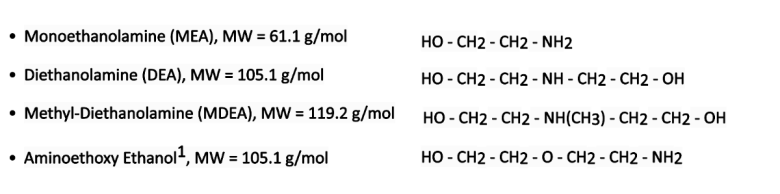
It’s important to mention that, in addition to standard solvents, there exists a diverse range of proprietary amine mixtures and physical solvents. These formulations are typically constructed using conventional solvents or their mixtures, incorporating proprietary additives or newly developed chemicals to achieve specific absorption/selectivity/stability properties of the final solvent. However, solvents of this specialized nature are beyond the scope of this chapter.
Each amine possesses specific properties for the selective absorption of CO2, H2S and other gas contaminants like COS or CS2. In general, the overall process is based on a reversible reaction between the amine (base) and the respective acidic species, as illustrated in simplified Equation 1-4.
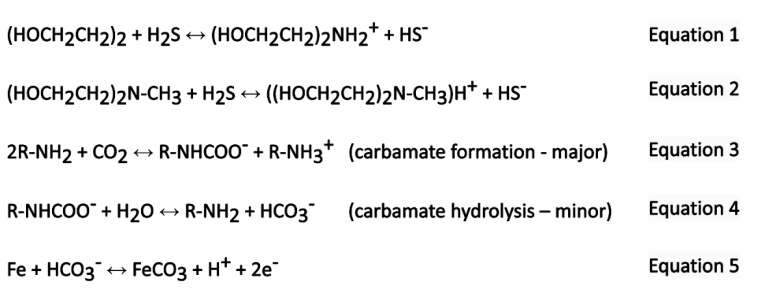
These and other reactions have implications for the corrosiveness of the amine solution. For example, increasing the amine concentration and CO2 gas loading will inevitably lead to a higher concentration of HCO3-, which triggers the corrosion reaction, as illustrated in the example Equation 5.
Since the equilibrium of reversible reactions is dependent on temperature and concentrations of individual species (with pressure playing a negligible role in the given system), it is imperative to maintain specific process temperatures, amine concentrations, and acid gas loadings to minimize solvent corrosiveness. Table 1 provides examples of widely used solvents, along with their typical maximum loads for rich and lean streams.
Table 1 Popular solvents, typical concentration ranges, max loads and other information. 3 4 5 6
| Solvent | Type | Selectivity & properties | Conc., wt.% | Rich load, mol/mol | Lean load mol/mol | Reboiler T, °C |
|---|---|---|---|---|---|---|
| MEAi | Primary | Not removing COS & CS2 | 15-30 | 0.30-0.45 | 0.10-0.15 | 115 |
| DEA | Secondary | Partly removing COS & CS2 | 20-30 | 0.40-0.70 | 0.05-0.08 | 118 |
| MDEA | Tertiary | H2S selective | 50-55 | 0.45-0.50 | 0.004-0.01 | 121 |
| DGA®ii | Primary | Removing COS & CS2 | 40-60 | 0.30-0.40 | 0.1 | 127 |
Mechanism
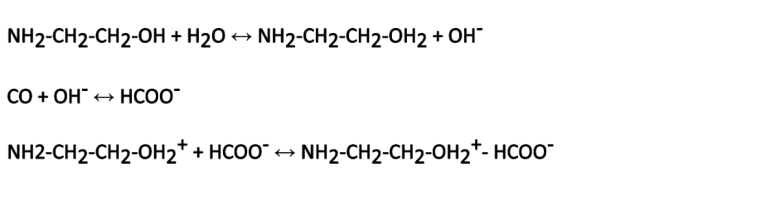
Pure alkanolamine solutions are normally considered as non- or low corrosive to carbon steel. Absorption of acidic components will increase solvent corrosiveness in the way shown on below reactions (A). The presence of contaminants like O2, CO or SO2 is another factor that will impact on amine’s corrosivity. These contaminants will cause amine degradation as shown in a few example reactions below (B).
Organic acids formed in this process will react with amine (base) and will form respective salts. These salts cannot be decomposed to amine and acid in typical regeneration process (hence, are called typically Heat Stable Amine Salts – HSAS) and will cumulate in solvent causing increase of its corrosivity. Each solvent exhibits a distinct decomposition pattern, leading to varying setups and concentrations of HSAS.
A: Reactions with CO lead to stable amine carbamate.
B: Oxidation, which continues (based on oxygen supply) from formation of amino acid (glycine), up to oxalic acid. Oxalic acid at elevated temperature (>120°C) will decompose to formic acid.
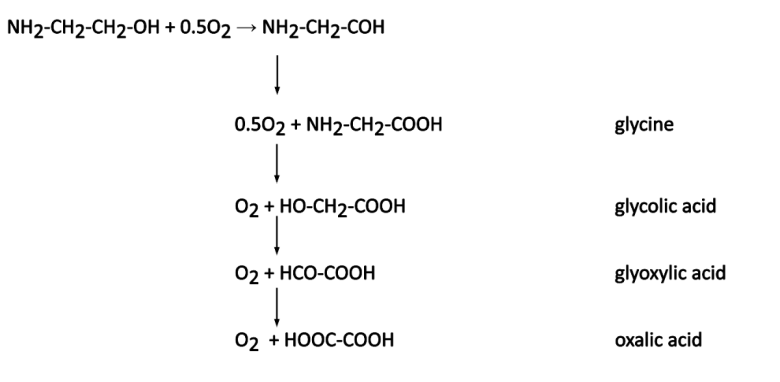
Above reactions represent only a small portion of potential degradation paths present in various solvents and with different contaminants. The concentration of Heat Stable Amine Salts (HSAS) is one of key-controlling factors that helps mitigate amine corrosion.
Key variables
Amine corrosion, like many other damage mechanisms, is affected by operating parameters such as temperature and flow (velocity/WSS). Additionally, the corrosiveness of alkanolamines is governed by the solvent type, its concentration, and the concentration of contaminants (which are also influenced by the type of contaminants) or acid gas load.
Amine type and concentration
As highlighted earlier, pure alkanolamines are not particularly corrosive, and their aggressiveness results from absorbed gases such as CO2 and/or H2S. Primary amines (like MEA) are generally considered to be more aggressive than secondary (DEA) and tertiary (MDEA). These expectations are overly simplified because the final corrosiveness of a given solvent will be a superposition of amine type, concentration, and specific setup of other variables (acid loading, temperature etc.). Figure 2 shows a change of MEA corrosivity under increasing amine concentration.
To see all graphics please upgrade your subscription.
Temperature and acid gas loading
Chemical reactions typically adhere to the general temperature-reaction rate relations described by the Arrhenius equation. Corrosion reactions in alkanolamine solutions are no exception and follow the same principle. Since the absorption process is exothermic, the temperature inside the contactor/absorber will locally increase, leading to the formation of hot spots (>90°C / >194°F) conducive to corrosion activities (refer to Figure 3). The rich amine stream exiting the absorber typically maintains a temperature range of 70-80°C (158-176°F), thus exhibiting relatively lower corrosiveness up to the flash-tank. However, this condition may vary with the increase in amine strength and acid load, as demonstrated in Figure 4. For typical acid gas load values concerning common solvents, please consult Table 1.
To see all graphics please upgrade your subscription.
Flow
Flow-accelerated corrosion can occur even in seemingly ’non-corrosive’ solvent streams, where parameters such as acid load, HSAS, or temperature are within ‘safe’ boundaries. This issue is often overlooked by designers who may be misled by various ‘industry-accepted’ rules of thumb, sometimes endorsed by standards like API RP 571, API RP 581, or API RP 945. Additionally, operators managing specific amine unit configurations may lack full control over flow in certain segments of the unit. Table 2 provides some typical velocity limits for popular solvents.
To see Tables please upgrade your subscription.
Expectedly, there is no clear consensus on amine velocity limits; however, most authors seem to accept the range of 1.5-1.8 m/s (5-6 ft/s) for the rich stream. The boundary for lean amine flow velocity is even less clear. It appears that 6 m/s (20 ft/s) for lean solvent is too high, and a more reliable or conservative level would be in the same range as for rich amine (1.5-1.8 m/s).
It is important to emphasize that maintaining low velocity does not always equate to minimizing flow-accelerated corrosion. Flow restrictors such as tees, elbows, or weld protrusions may locally generate flow turbulence, ultimately leading to elevated corrosion. Therefore, it is crucial for designers and plant engineers to consider not only flow velocity but also Wall Shear Stress (WSS) as a parameter that can accurately assess adequate flow boundaries.
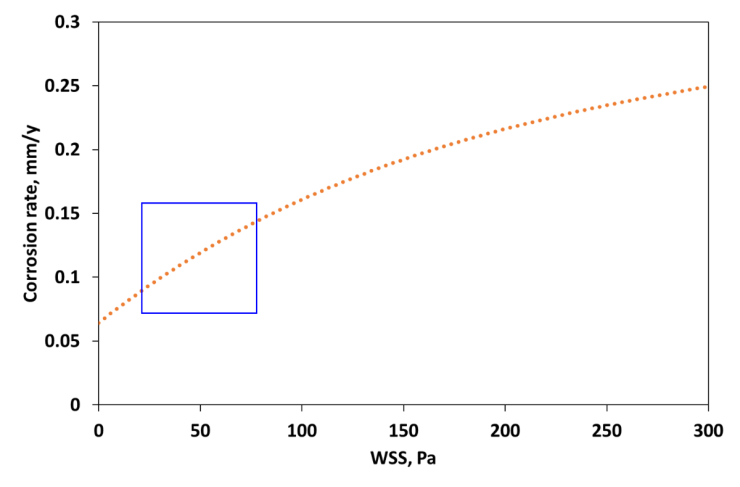
Generally, within normal operating flow and with a single liquid phase system, WSS does not change dramatically (e.g., from 50Pa to 100Pa). However, this increase can potentially raise the corrosion rate by 10-20%, which might be sufficient to damage specific pipe areas before the planned inspection interval (refer to Figure 5).
In two-phase flow scenarios, such as in the reboiler and reboiler-to-stripper loop, the situation becomes even more dynamic. Here, the effects of flow and values of WSS can become locally very high, potentially impacting even corrosion-resistant alloys. This, coupled with overlapping actions from evaporation, HSAS deposits, etc., may ultimately lead to elevated corrosion.
Contaminants/Heat Stable Amine Salts (HSAS)
The presence of contaminants such as oxygen, CO, or COS, as well as temperature-driven amine decomposition processes that occur independently of the contaminants, slowly deteriorates the solvent properties. The basic mechanism of HSAS formation is relatively simple: strong organic acid anions formed during decomposition (refer to Mechanism) replace weaker acid anions HS- and HCO3- in the respective amine-acid gas reactions. Because organic acids cannot effectively leave the amine solution during the regeneration process (e.g., CO2 and H2S readily evolve from the solvent), the concentration of amine molecules bonded with strong acids will increase over time, reducing amine absorption capacity.
Additionally, lighter acids such as formic and acetic may evolve inside the reboiler due to temperature, accelerating corrosion not only of carbon steel but also of popular austenitic steels (304L/316L). Other compounds formed from the decomposition of amine solvents, such as thiosulfates, amine-acids like bicine or glycine, and complex decomposition products like N-(2-hydroxyethyl)-ethylenediamine (HEED) and N,N’bis(hydroxyethoxyethyl) urea (BHEEU), will also affect the solvent’s corrosiveness.
There are several methods to reduce HSAS, including traditional thermal reclaiming (low pressure), vacuum distillation, ion-exchange, electrodialysis, etc. However, the most popular technique for reducing HSAS in solvent circulation remains side-stream (typically 0.5-5% of the total volume) thermal reclaiming, which is successfully used in MEA and DGA units, for example.5 Specific details of reclaiming technology are beyond the scope of this document.
The more critical factor is related to the overall concentration of HSAS and its control during normal amine unit operation. It is important to highlight that the generic guidelines on HSAS concentration levels published in API documents (API RP 571, API RP 581, or API RP 945) should be treated carefully. Another element, sometimes overlooked by engineers, is the expression of HSAS concentration – whether with respect to the total mass of solvent or with respect to amine alkalinity. It should always be clearly stated whether a given HSAS concentration is referred to as amine or total solvent, for example, “2 wt% HSAS as amine.” Otherwise, there will be confusion regarding maintaining the adequate HSAS level. For instance, with a 50% amine concentration and HSAS of 2.5 wt% as amine, the HSAS concentration in the solvent would be approximately 5 wt%. Table 3 provides examples of HSAS levels for different solvents.
To see Tables please upgrade your subscription.
The total HSAS concentration serves as a general guideline for establishing control boundaries. However, for specific amines, it is imperative to also have detailed rules for individual HSAS ions, such as formates, thiocyanates, or thiosulfates, as well as the concentration of amino acids and complex decomposition products. These elements, whether considered individually or jointly, may significantly increase the solvent’s corrosivity. Table 4 provides examples of concentration levels for major HSAS ions and other compounds that may influence the solvent’s corrosiveness.
Except for commonly accepted limits for thiosulfates, thiocyanates, and formates (1 wt.%), as well as acetates and chlorides (1000 ppm), limits for other contaminants are not always clear. These limits sometimes vary between 0 and 1000 ppm, depending on the specific amine and acid gas load. Similarly, limits for amino acids (such as bicine) or amine condensation products (like diamines such as THEED) are also not clearly established and may range from 2000 ppm to less than 250 ppm, or for THEED (DEA) less than a 1.5 wt.% solution.18 24 These observations confirm the hypothesis that “safe corrosion” concentration levels for individual contaminants should be used with caution, and their impact should be analyzed individually based on the amine type, acid gas loading, or overall operating conditions.
To see Tables please upgrade your subscription.
Materials
To obtain more information about material selection in amine environment please upgrade your subscription.
Tools
Below are our user-friendly calculators and integrity tools to estimate amine corrosion of carbon steel and selected CRAs.8
To Obtain Full Access please upgrade your subscription.
To access our Tools, please subscribe to the appropriate level. A Professional subscription is required for the general Amine Calculator, while the Amine Integrity Risk Indicator (IRI-Amine) - including the risk quantification and sensitivity analysis features requires a Professional + access.
Amine-Corrology®
Amine-Corrology® is designed to provide rapid corrosion rate estimates for carbon steel and stainless steels in amine service. It comprises a dedicated flow modelling engine, which allows you to evaluate the impact of flow parameters like Wall Shear Stress (WSS) and velocity on corrosion rates.
NOTICE: The provided tool is for advisory purposes only. Corrology Innovations Limited and its employees shall not be held liable for any damages, resulting from the use or inability to use the information provided.
Integrity Risk Indicator (Corrology®-IRI: Amine)
The Challenge: Moving Beyond Linear Estimates
In amine service, traditional linear corrosion tracking often fails to capture the rapid transition to accelerated damage. As wall thickness decreases, risk does not grow steadily - it accelerates exponentially. Small changes in amine type, concentration, HSAS levels, or temperature can also shift equipment from a stable operating window into a severe-corrosion regime.
The Solution: The Amine Integrity Risk Indicator (IRI-Amine)
The IRI-Amine quantifies asset risk by calculating corrosion rates, service-life context, and empirical remaining-life indicators through a margin-aware, API 581-inspired engine. This tool functions as a sensitivity analysis engine, allowing you to evaluate how shifting amine concentration, temperature, HSAS levels, and flow velocity impact carbon steel and Corrosion Resistant Alloys (CRAs) in Predictive Mode to determine the most robust material for your specific operating window.
The Advantage
Access a high-speed, agile modeling engine designed for rapid, defensible engineering decisions:
Non-Linear Risk Scaling: Utilize a logarithmic-exponential transformation that reflects the true physical reality of risk escalation in late-life degradation states.
Dynamic Inspection Credit: Input your Inspection Effectiveness (Class A-E) to see how high-quality data reduces uncertainty and optimizes maintenance intervals.
Auto-Derived Prior Confidence: Prior confidence is automatically computed from the uninspected time interval (tuncertainty): <3 years = High, 3-5 years = Medium, >=5 years = Low. This applies in both Predictive and Inspection modes and remains read-only in the standard UI workflow; API and integration callers may pass priorConfidenceOverride or priorConfidence when an explicit override is required.
Precision Structural Floors: Take control of your model by setting Manual T-Min structural floors to match your equipment’s unique geometry.
Expert Calibration: Gain confidence with a model structured against a 6-point lifecycle truth set, ensuring accuracy from low-risk early life to critical thin-wall scenarios.
API 581-Aligned Risk Bands: Status and score-pill color are determined by the log probability of failure (log Pf) rather than the 0-100 score scale alone. Thresholds follow API 581 PoF magnitude ranges: log Pf <= -5 = Very Low; -5 < log Pf <= -4 = Low Risk; -4 < log Pf <= -3 = Moderate; log Pf > -3 = Critical. This ensures that improvements in inspection effectiveness are always reflected in the displayed risk band, even in high-age or thin-wall scenarios where the numerical score is saturated.
Note: The Integrity Risk Indicator (IRI) shown below is a static preview. To unlock the live, dynamic risk indicator and manual structural overrides (t_min), upgrade to Professional +.

References
    This Article has 24 references.

    Upgrade to a Paid Subscription to see the references details.
- i- Parameters like max loading and concentration will depend on several factors like presence of H2S, inhibitors etc.
- ii - Aminoethoxy ethanol known by trade names DGA® or Diglycolamine® which are registered trademarks of Huntsman Corporation.