Polythionic Acid Stress Corrosion Cracking
General Information
Polythionic Acid Stress Corrosion Cracking (PTASCC) is a form of intergranular cracking that requires coexistence of three elements: a susceptible material (e.g. sensitized austenitic stainless steels and some Ni alloys), presence of polythionic acids and stress.1 2 Therefore, PTASCC occurs commonly in areas typically operating in range of 370-843°C (700-1550°F) where sensitization of austenitic materials will progress.2 3 4
Polythionic acids, the second element, are typically formed during shutdown or process upset events when oxygen and water/moisture ingress may take place. Stress, the third necessary element for PTASCC and typically arises during cold and/or hot mechanical operations such as welding and bending. The interaction of these three elements is schematically shown in Figure 1.
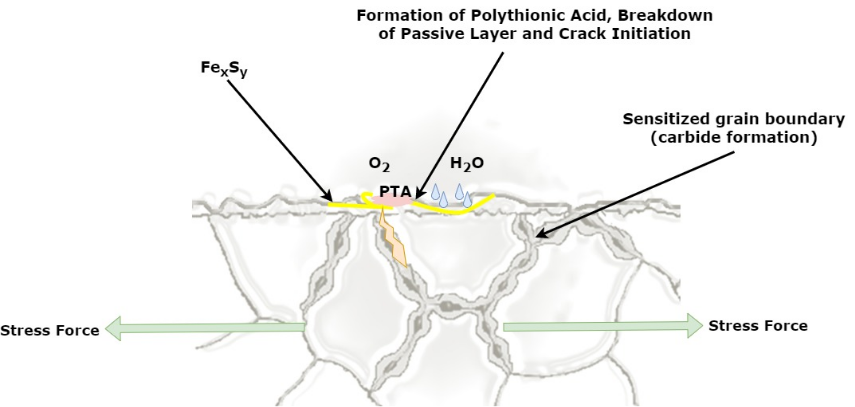
The most common areas of PTASCC are listed in Table 1.
Table 1 Typical Areas for PTASCC in Refining and Petrochemical Industries. 1 2 4 5
| Unit | PTASCC Affected Area | Comments |
|---|---|---|
| Steam Reforming | Heater tubes | External PTASCC when using sour fuel |
| Catalytic Reforming | Feed/effluent exchanger | Hot side |
| Hydrocracking | REAC | - |
| Hydrotreating | Feed heater tubes Feed/effluent exchanger | - |
| FCC | Reactor Regenerator Overhead line Flue gas line Expansion joints | Typically, at HAZ areas |
| CDU/VDU | Atmospheric and Vacuum heaters tubes | It is believed that oil film and/or coke layer may reduce the likelihood for PTA attack |
| SRU | Acid gas preheaters | 321 steel |
Mechanism
Role of Sensitization: The sensitized austenitic material is a key factor in the occurrence of PTASCC. Sensitization results from carbide precipitation at the grain boundaries of austenitic (300 series) and ferritic-martensitic (400 series) stainless steels. This process occurs when these steels are exposed for prolonged periods to temperatures typically ranging from 537°C (1000°F) to 843°C (1550°F). Carbide formation depletes the areas near the grain boundaries of the alloying element (chromium), making these areas susceptible to intergranular cracking when exposed to an aqueous corrosive environment.3
Carbide precipitation occurs spontaneously during normal process operation, material fabrication, or welding. Sensitization can be slowed down either by limiting the amount of carbon present in the material—hence the use of low carbon (L) stainless steel grades—or by adding elements such as titanium and niobium (use in steels type 321 and 347), which have a higher affinity for carbon and replace chromium in the carbide composition.
While sensitization is relatively simple in its fundamentals, it is a complex process influenced by a combination of material composition, temperature, and exposure time. Moreover, when steels are sensitized, they can undergo a reversal process known as desensitization when exposed to high temperatures (>650°C / >1202°F) for prolonged periods. Although slower, this process can mitigate the negative effects of sensitization to some extent. The temperature at which sensitization starts varies for different materials, as shown in Table 2.4
To see all Tables please upgrade your subscription.
Hot work, such as welding, can sensitize the material due to the locally applied heat flux. Therefore, post-weld heat treatment (PWHT) is essential for mitigating PTASCC. Typically, all steels and alloys operating in PTASCC-risk environments are used in a solution-annealed state, and areas of hot work (welding) are subject to mandatory PWHT. An example of a generic, qualitative ranking of PTASCC risk versus operating temperature and PWHT for various materials is presented in Table 3.6
To see all Tables please upgrade your subscription.
Polythionic acids: Polythionic acids (PTA) are a group of oxoacids with the general formula H₂SₓOᵧ, where x is typically in the range of 1 to 5 and y is from < 1 to 6. PTAs are formed during the oxidation and hydrolysis of iron sulfide films present on the surface of austenitic stainless steel, as shown in the example equation below:
\(\ce{2FeS + 4O2 + H2O -> H2S2O6 + Fe2O3}\) Equation 1
It is important to highlight that PTAs may form not only from FeS but also from other oxidizable sulfur-containing species such as H₂S.
Water is typically introduced to the unit during the steaming operation, which is conducted to purge any remaining hydrocarbons. Oxygen, on the other hand, is usually sourced from the surrounding air when the unit is open to the atmosphere. Additionally, oxygen can enter the system through air-contaminated nitrogen, which is often used in purging and blanketing during shutdown operations. However, the above examples do not account for all potential sources of water and oxygen. Therefore, it is important for process engineers to conduct a thorough analysis of the system, identify all possible entry points for water and oxygen, and assess the risks associated with the formation of PTAs.
Tensile stress: The third element required for PTASCC is the presence of tensile stress. This stress can be either residual or applied. Residual stress often arises from fabrication processes such as welding, machining, or hot/cold forming. Applied stress, on the other hand, comes from mechanical loads imposed on the material during service. This could include pressures from internal fluids, external forces, or even thermal expansion and contraction. Both residual and applied stresses contribute to the susceptibility of austenitic stainless steel to PTASCC. The specific levels of tensile stress and the degree of sensitization required to initiate PTASCC are not well understood. Given these uncertainties, it is crucial to implement relevant stress relief practices as one of the preventive measures.
Prevention and Mitigation
Like any other stress corrosion cracking mechanism, PTASCC can be prevented by disrupting or eliminating one of the components involved in the interaction matrix of parameters. This matrix includes factors such as the presence of tensile stress, the material’s susceptibility to sensitization, and the corrosive environment containing polythionic acids. Disrupting one or more components within this interaction matrix—whether it’s tensile stress, material sensitization, or exposure to corrosive environments—can effectively prevent PTASCC. Table 4 presents various mitigation strategies and practices aimed at preventing Polythionic Acid Stress Corrosion Cracking (PTASCC).4
To see all Tables please upgrade your subscription.
References
    This Article has 6 references.

    Upgrade to a Paid Subscription to see the references details.